My Sketching Essentials…

There are so many supplies available for the artist to work (or play) on the go.  The equipment can get really elaborate as well as expensive.  So, I have put together a few things I have carried with me from time to time with no problems.  By problems I mean,  I have never sat down to sketch and said, “Man! I wish I would have brought_____!”

Sketching

DSC_0012

I am first and foremost a graphite girl! I like to draw on a smooth papers. And the above are  my papers of choice.

400 Series Strathmore Drawing Pad – 8 x 10, 80 lb., pad is coiled so it folds flat (which is awesome).  Paper has a slight tooth, but I still consider this a smooth(ish) paper.

400 Series Strathmore Sketch Pad – 5.5 x 8.5, 60 lb., pad is also coiled, slight tooth and not as thick as the 80 lb.

-Canson Drawing – 5.5 x 8.5, 70 lb., pad is coiled and has very little tooth.  It is the mid range weight between the two pads above.

-Canson Drawing – 5.5 x 8.5,  65 lb., pad is coiled, slight tooth and also a good mid range weight

The two Canson pads are not available, but here is a link to see the Canson line.

Moleskine Journal – unlined, stapled and smooth tooth, compact and very versatile.

Tools
pencil

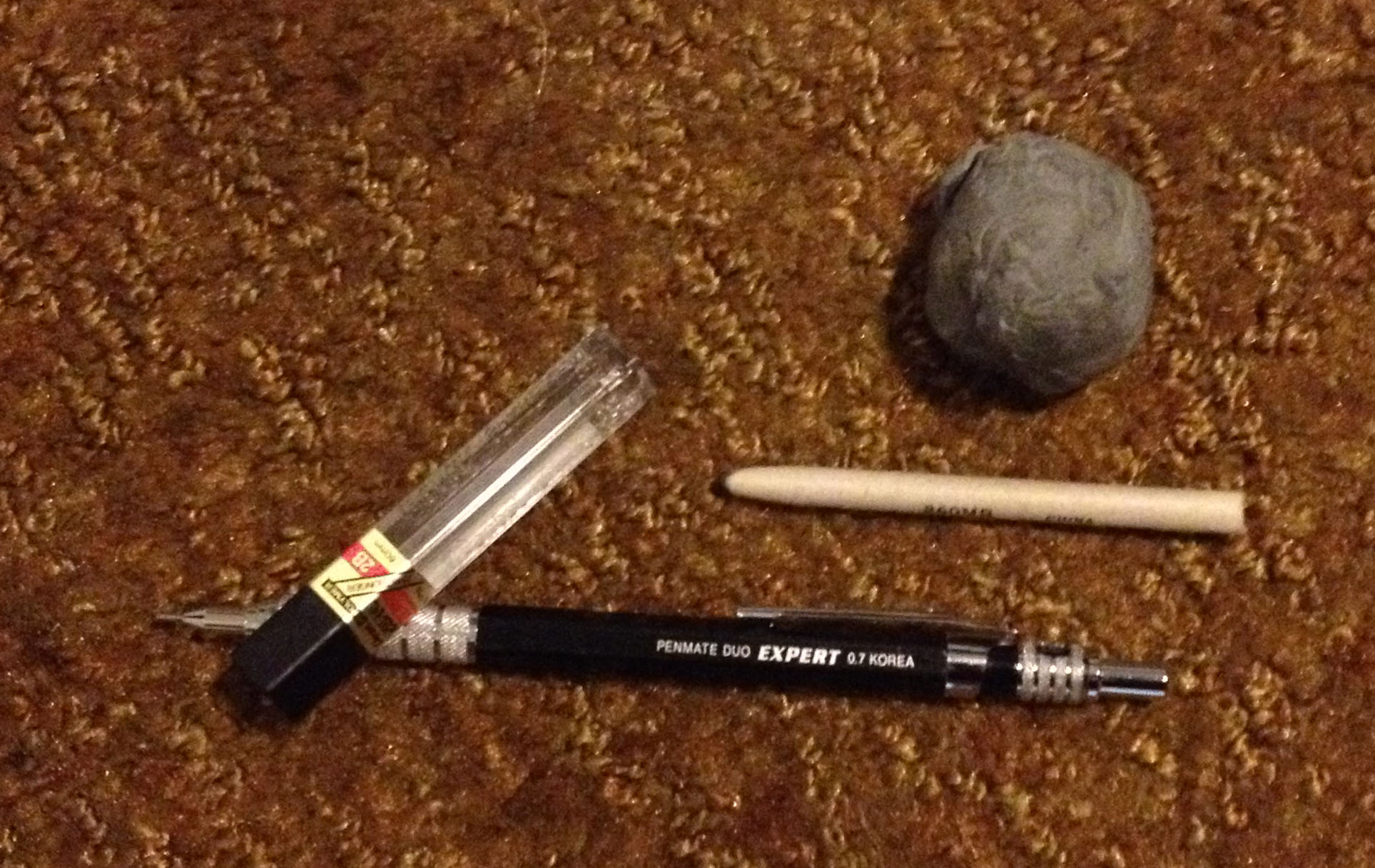
These are all the tools I need to keep me happy!

A stump – for blending

A kneaded eraser – erasing mistake of course 😉

2B lead – a very versatile degree of graphite. Depending on the amount of pressure and using a stump, this one soft graphite can give you anywhere from a 4H, 3H, 2H, H, HB,  as well as 2B!

Lead Pencil – Trimming your pencil may not be an option, so for me a lead pencil is a definite must.

When I want to sketch on the go and I don’t want to or can’t take a bigger pad.  I throw a Moleskine, stump, kneaded eraser, lead and a lead pencil in a Ziploc baggie and off I go!

Colored Pencil…Would be essentials

DSC_0014

I rarely take colored pencil on the go.  I may if we are traveling by car, but not usually as a rule.  If I decided to and I had no plan in mind, this is what I would probably take with me. I bought this portfolio from Dick Blick many years ago, and I love it.  The portfolio holds a pad of paper, 12 Prismacolor Pencils, and a sharpener.

The additional pad:

300 Series Strathmore Bristol Smooth – 6 x 6, 100 lb. paper, heavyweight paper that will hold many layers of pencil.

Tools

-Colored Pencil Portfolio – I bought this on clearance for a whopping $20.00…ikr, yay me!  Sadly, I don’t think this is available anymore.

A 12 color pack of colored pencils

A kneaded eraser

-Sharpener

Lead Pencilnot shown.

typing eraser – great hard eraser

Prismacolor blender pencil

-A Baggie – for pencil shavings

Watercolor….Would be essentials
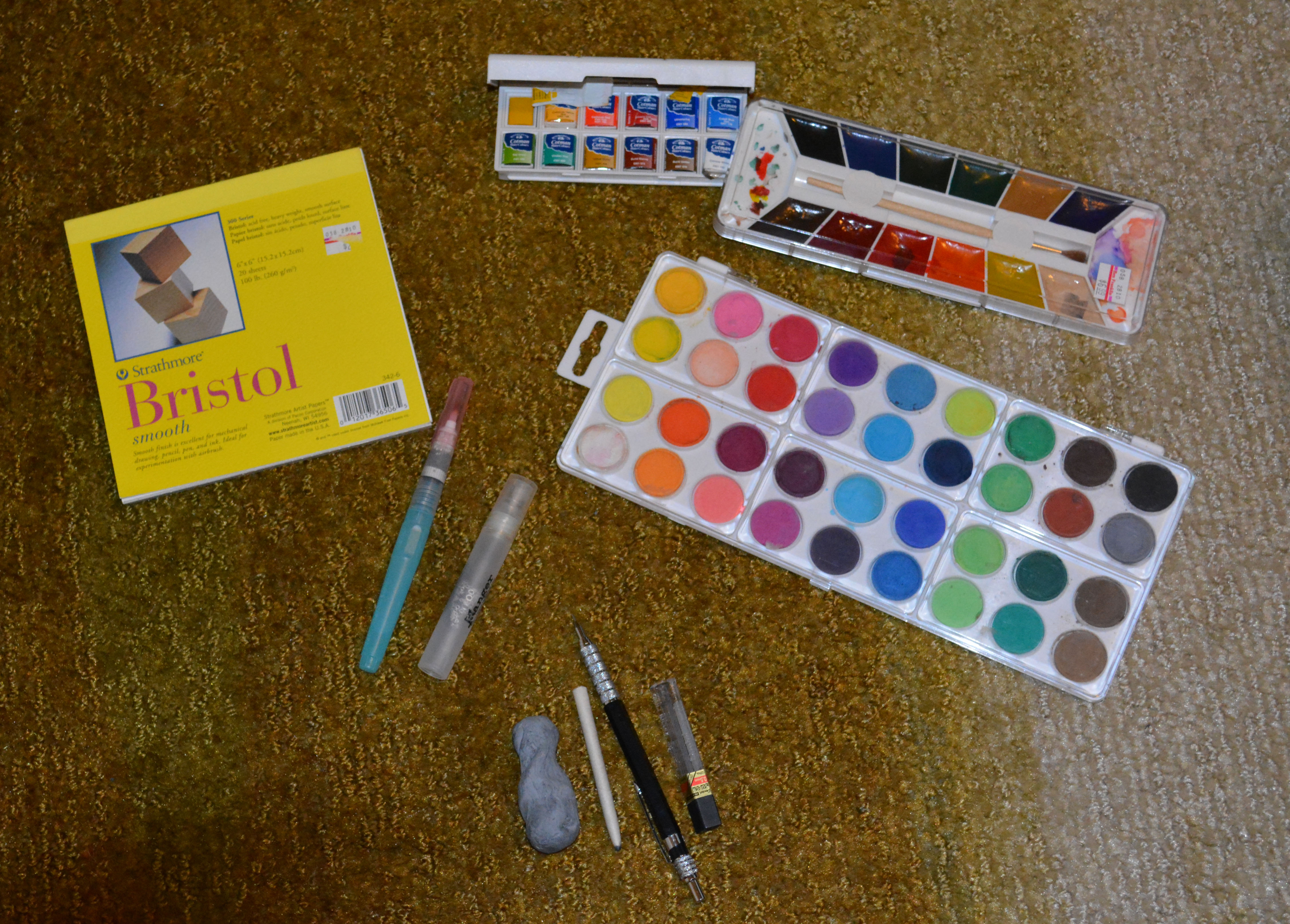
DSC_0018

I haven’t had the pleasure of working in watercolor (yet).  But I do have a few things that I would choose as my essentials if I were to paint on go.

Paper

300 Series Strathmore Bristol Smooth – 6 x 6, 100 lb. paper, heavyweight paper that will hold many layers of pencil.

Other watercolor pads

Tools

Loew-Cornell dry watercolor pan

-12 color pan no longer available
Winsor & Newton – 12 color travel set – linked to a similar set

or Watercolor Pencils not pictured

Travel water brush

-A Mister

-a folded paper towel not pictured

A stump

A kneaded eraser

2B lead

Lead Pencil

Ink

DSC_0020

Sometimes, I want to  Zentangle  and this is perfect to throw in my purse!

Paper

300 Series Strathmore Bristol Smooth – 6 x 6, 100 lb. paper, heavyweight paper

Moleskine Journal – unlined, staples and smooth., compact and very versatile.

Tools

Micron Pens

2B lead

Lead Pencil

A stump

A kneaded eraser

I think oil and acrylic would fall under the en plein air category.  And since we all can’t know everything I have no idea what a charcoal or pastel artist would carry.  But I would definitely be interested in finding out.

Nothing is set in stone and you should carry what makes you feel comfortable. For me these things mentioned is what makes me comfortable to sketch in the past and what I shall continue to have with me in future.

What are your go to sketching essentials?

Be Well and Happy!

What is sketching?

Sketching is quick drawing and/or painting studies.  Oftentimes, artists uses thumbnail (miniature) sketches before beginning larger works. This enables the artist to make adjustments in perspective, design, color and cohesiveness before beginning larger works.  Sketching is also practiced for relaxation, introduction to new mediums and as well as for someone who wants to learn to draw.  So, it stands to reason that a sketch book is a collection of all that has been mentioned above.

There is some debate in the art community whether graphite drawing is considered a legitimate medium.  Some believe that drawing falls under the sketching category, while others believe that drawing should receive the same accolades presented to other mediums.   Myself?  If you want to make me good and mad?  Tell me a drawing that I have 80 hours invested in is a nice sketch and I will go from zero to wolverine with no stops in between.   But I digress…

If you want to start sketching, the most important question you should be asking yourself and thinking about is what medium are you going to use in your sketchbook?

Will you be using dry mediums?  Such as:

 graphite?

colored pencil?

ink?

charcoal?

pastel?

Or will you use wet mediums? Such as:

watercolor?

qouache ?

I would not recommend oil or acrylic.  The drying time for oil and acrylic takes too long.  You may be able to use acrylic, if it is used as a wash and you have a spiral bound sketch book that can lay completely flat.  Acrylic can take up to an hour to dry so be aware….

Whatever medium you choose will have a great bearing on what type of sketchbook that you would need to purchase.

So, I guess that is where I am going to leave today…In contemplation…

Be Well and Happy!

To sketch or Not to sketch?

Yep, that’s my question.

I was creeping in on a discussion from a popular artist in one of my online groups.  The short version of this discussion was that she was informally accepted in a Gallery, but they wanted or needed to see her sketch books.  WTW, sketch books?  I don’t keep sketch books!  How do you keep a sketch book?  The poor woman was coming unglued.  Of course, their were lovely people a plenty on hand to help her in her hour of need.  But it got me thinking.  I wonder how many artists out there keep a working, bona fide sketch book?  I use to keep sketch books a long time ago, but not in years have I sat down and intentionally sketched for the sake of sketching.  And I couldn’t find them now if my life depended on it.

Have you ever kept a sketch book?

Do you keep a sketch book now?

Would it be a prudent move in your career to start keeping a sketch book?

I’m thinking that it’s a definite yes!  You and I should!

Don’t get me wrong, I draw and paint because the desire to do so is there.  But Come On, I’m not an idiot, LOL  And if by chance, in my wildest dreams a Gallery approaches me, I want to be ready!  And if not, then we will have some awesome coffee table books 🙂

I think I am going to dedicate at least couple of posts to this very subject…I’m a little rusty, but I am more than willing and happy to share what I know.

AND If you are subscribed to this blog and have always wanted to learn to draw but can’t?  This would be especially helpful for you 🙂

Be Well and Happy!

Happy 2014!

Lola jpeg

“Lola”

Graphite on Bristol Smooth

I hope this post finds everyone excited for the new year.  I know there are a lot of exciting things happening this year in the Ottaway household.  So much so, that I don’t think I could handle making any resolutions let alone keep them.  I hope times are as good as I anticipate them to be,  though they may become a little bittersweet.

Above is a commissioned piece that I completed over the holidays.  Sadly, this lovely girl has crossed over the rainbow bridge.    But you can tell she was probably a rambunctious little priss pot and spoiled rotten by her owner, lol

Not a whole lot going on right now to blog about.  I have been spending my time like everyone else. I ate so much food that my jeans are tight and the thread is screaming.  I watched  a copious amount of Hallmark movies. I enjoyed a lot quality time with my loves (more than they would have liked) , and A LOT of time spent in my P.J.s.  That’s pretty much it.

I have a few things planned for my blog, so stay tuned!

Be Well and Happy!

Tricks and Troubleshooting…

  1. Rubber shelf liners are perfect to lay under your work area.  The rubber like quality will keep your pencils from rolling in the floor and breaking.
  2. When your lead is broken in the shaft.  you can wrap the pencil in a paper towel and microwave for a few seconds at a time.  When your pencil is very warm to the touch, lay the pencil to the side until the wax/oil hardens.  (the broken pieces will melt and harden back in to one piece)
  3. Can’t find that perfect colored paper?  Simply paint your white paper with a watercolor wash for custom colors.  You may need to do a test on scrap to make sure your paper doesn’t buckle.
  4. Always wear a max when working with solvents and in a well ventilated area.  Even if the solvent is odorless the chemicals are still in the air.
  5. Dust off your pencil after every sharpening to avoid smearing the color dust on your work.
  6. Workable fixative will add more tooth to your paper.
  7. Unless the drawing aspect of your painting is off, keep going no matter how bad you think it looks.  The painting will have  ugly stages. It is during the ugly stages when most  gives up. DON’T ! Keep going until you are either satisfied or have no more tooth left to work with.  I have to remind myself of this constantly, with any medium.
  8. If you lose you whites, you can go over that area with a little gouache or a white Stabilo pencil. Be aware!  If you use these methods, your piece becomes a mixed media for contests in most cases.
  9. If your pencil is too short, super glue your pencil stump  to a longer colored pencil of the same color.
  10. I learned this lesson the hard way!  If have to trim a brand new pencil, make sure the color the number and color is on the opposite end of where you are sharpening.


I hope you have enjoyed this little mini series. I certainly enjoyed sharing.   If you want to learn anything that I glazed over, it can be found easily on the internet.    Best of Luck in Colored Pencil endeavors!

Other Lessons:

Color Wheel and Color Theory

Techniques 1

Techniques 2

Mixing Colors

Mapping Color

More on Colored Pencils

Be Well and Happy!

More on Colored Pencils.

pencils

Lighfastness

Lightfastness is how fast the colors lose their vibrancy and fade due to chemical breakdown in direct sunlight.  Most if not all colored pencil manufacturer’s have some pencils colors that are more robust and handle the sunlight better others.  Some artists will choose pencils that are more lightfast.  All mediums stand the risk of fading as well as anything exposed to UV rays.  My opinion is, anything with any pigment or dyes exposed to the direct sunlight will fade over time, so I don’t concern myself too much.

To aid in preventing your art from fading, Don’t hang your art near windows and doors. OR Make a print of your art and store the original in dark, dry place at room temperature.

Wax Bloom

Wax Bloom is the oxidation of the wax creating a white cast of film over your completed art.  To combat this:  First wipe your art down with a dry soft cloth and spray with a fixative.

Next week will be the last post in this series. Below, you see prompts for you to color map and paint.  It is not necessary to use my prompts.  Walk around your home.  Choose simple items in color and design, paint the items in your purse, tool bag, or junk drawer.  Choose anything, everything.

  1. leaf
  2. light bulb
  3. tree bark
  4. your favorite beverage
  5. all or part of a remote
  6. your front door
  7. a tube of lipstick / chap stick
  8. a tool
  9. a kitchen utensil
  10. a cookie
  11. sunglasses
  12. gloves
  13. jewelry
  14. a child’s toy
  15. a coaster
  16. a candle
  17. purse / wallet
  18. comb
  19. a colored pencil
  20. breakfast food
  21. favorite keepsake
  22. snack
  23. hairbrush
  24. a book
  25. nail file

I can’t stress enough how important it is to be proficient in mapping color.  It may be a pain, but it is so easy and helps you stay quite a few steps ahead of the game.

Other Lessons:

Color Wheel and Color Theory

Techniques 1

Techniques 2

Mixing Colors

Mapping Color

Enjoy!

Until Next Week….

Be Well and Happy!

Mapping Color

When we buy a colored pencil technique book, we expect great things.  This book will answer all our questions, solve all of our issues and by the end we WILL be as good (if not better) than the author.  Then we go through book, screw up a few traced exercises then curse, scream and set the book on fire!  Well, no… not really but if you have worked with the demos, you have wanted to.    I have learned some great tricks in colored pencil,  but what I am saying is that you should not the last half of these books to teach you how to paint in colored pencil.  Teach yourself.

Let me go on record saying, “I love my colored pencil books and don’t see them as a waste of money. But authors have been painting for years and years before they had their very own book published. Those exercises are just too difficult for the novice.”

It took a long time for me to figure out that in trying to paint those demos, what I was actually doing was trying to replicate the “style” of the artist. I was learning nothing, and if by chance I did complete a demo, I could not paint another using my own reference.  I don’t know about you but I’m not a protégé of one the old masters.  I don’t want to waste time studying their style of art to crank out pieces…or not able to crank out anything.

Out of all the mediums, colored pencil is the most difficult to manipulate because it is pushed to the very boundaries of its capability.  Colored pencil is not an easy medium to learn, but with a little planning you can be more confident in your endeavor.

Do you remember when you were in high school and the Geography teacher made you draw and color key maps?  You know, color green, the region whose cash crop is peas and make the lakes blue…yada yada yada…..Painting in color pencil is similar to those maps, but only more intricate.

I am going to assume that you can draw a little bit, but even if you can’t this exercise should be fairly easy.

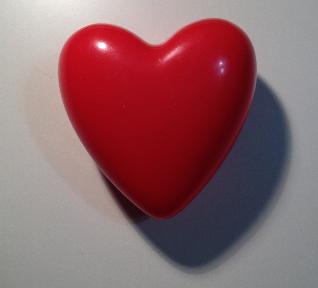
Below is a plastic heart that I found in my daughter’s room.  I chose this subject because it simple in design, it is bright but only has few colors.  It will also be your reference and your only demo (ish) in the series.

heart3

Drawing

heart2

As you can see, this line drawing is a little messy. I have a couple of smudges and eraser marks. These mars would be fine if I were drawing.  But in colored pencil,  the pencil marks would show up through the wax pencil and impossible to erase.  You can solve this by transferring your drawing on clean paper and in a few different ways using:  a projector, light box, graphite paper,  or simply taping your drawing to a window (during full sun)  with a clean paper overlay.  Use very light strokes just dark enough for you to see where the color goes. An even better solution is to use the basic color of your reference to outline the drawing (red heart=red or pink pencil)

  ****Just to be safe, always transfer your drawing!

Mapping Color

heart1 heart map

Mapping color is when separate the different colors and/or color changes in your drawing.  As your color changes within the same object you would use the graduation method using circular strokes in light layers to block in color. The more thorough you are in mapping out color the more realistic your art will be.

Above is the drawing with my colors mapped out.  The picture on the right is the same as the left but drawn in ink to make the heart more visible.

Color Choice Legend

From the numbered drawing above on right

1.) This indicates where my light source is coming from (top left almost center) and is called the highlight.  The highlight is the lightest part of the painting because that is where the light is concentrated.  Some artists go from painting the light colors first and the darks last, and others do the opposite.  Just paint what you feel confident with, but remember lighter mistakes are easier to erase.

2.) Is a darker value of base color.  The object is on a curve and it isn’t receiving as much light The lack of light causes a shadow because the light has move around the object.

3.) Is the graduation of the  darker base color and in to the overall color you choose for the heart.

4.) Is the reflected light and it indicates the shape of the object as the light curves around that area.

5.) Is a shadow.

6.)It’s the shadow’s edge.  Is a lighter hued shadow, but still a shadow

7.) Is the cast shadow and is the darkest area of the drawing.

8.)  The light can reach further around the object but  is still casting a light shadow of the true color of the heart.

***Whatever isn’t labeled, is the true overall color of your heart.

Blocking In Color

Blocking in color is the laying down of color in a very light layer indicating where you want the colors to go.  For example: I would paint in the shadow using a very light cloud blue or a gray to indicate where my shadow would go.  And after I mixed my red, I would use the lightest hue for the overall heart, and the darkest hue for the heart’s shadow.  I would save the highlights for last so I could burnish into the very white of the highlight.

This Weeks Lesson:

Draw this heart. Don’t draw the heart too big or too small.  If drawn too big, you will spend too much time on this and if you mess up, you will be too frustrated to try it again.  If drawn to small, you have a hard time navigating your way through will result in more frustration.

Then, after all of this and you are still wanting more?  Mix color chips and use the one and two color graduation.

Other Lessons:

Color Wheel and Color Theory

Techniques 1

Techniques 2

Mixing Colors

Enjoy!

Be Well and Happy!

Mixing Color

photo

Mixing color was my Achilles’s  heel.  I had so many colors, yet I could mix the right hue.  I know that a color doesn’t have to be exact but it didn’t stop me from want to copy that exact shade or wanting to throw my pencils in the woods when I couldn’t.  There are times when mixing the right hue (like skin) is pretty important and I just could not do it!

Now I find mixing color easy and I almost always mix the color right on the first try.  And instead of cursing all of my pencils and I am very happy that I have so many options.

By now, you should be well acquainted with your pencils. And remember the Color Family Sheets?  This is where they become integral in color mixing.

Value Finders

Black

   Value finders are small business card sized (card) stock in white and black with a hole in the center.  The finders are used to block the colors that surround the color that you want to mix.  It also changes how your mind interrupts the subject.  For example, Let’s say I am painting a gold candle holder.  If I look at the candle holder, my mind tells me  to pick up that gold metallic pencil. It’s gold right? I paint it gold.  It looks nothing like the holder, and I’m completely lost.

 This example is commonplace.  People have a hard time trying to wrap their head around seeing the color through the metal.  But, if I take that same candle holder and I place a view finder on top,  I don’t see the object or the values surrounding that object.  I only see the area color that I want to duplicate.  I paint the holder with  some ochres and goldenrod, maybe a little Jasmine and a couple of greens. Now,  I have a realistic gold.

Color Mixing

In colored pencil there are no formulas. Well, there is kind of, but that is dependent upon you.  Some people can achieve the desired hue using a couple of pencils and others it take more. It just depends on the way you see the color and the pencil combination that you choose.

Although mixing colors in colored pencil is not really an exact science, I will show you how I mix color as well as my thought process.  It’s simple and I have yet to find a  color that I can’t mix.  AND I found that this is so much fun, that I ran out of chips and went back to Lowe’s to get more.

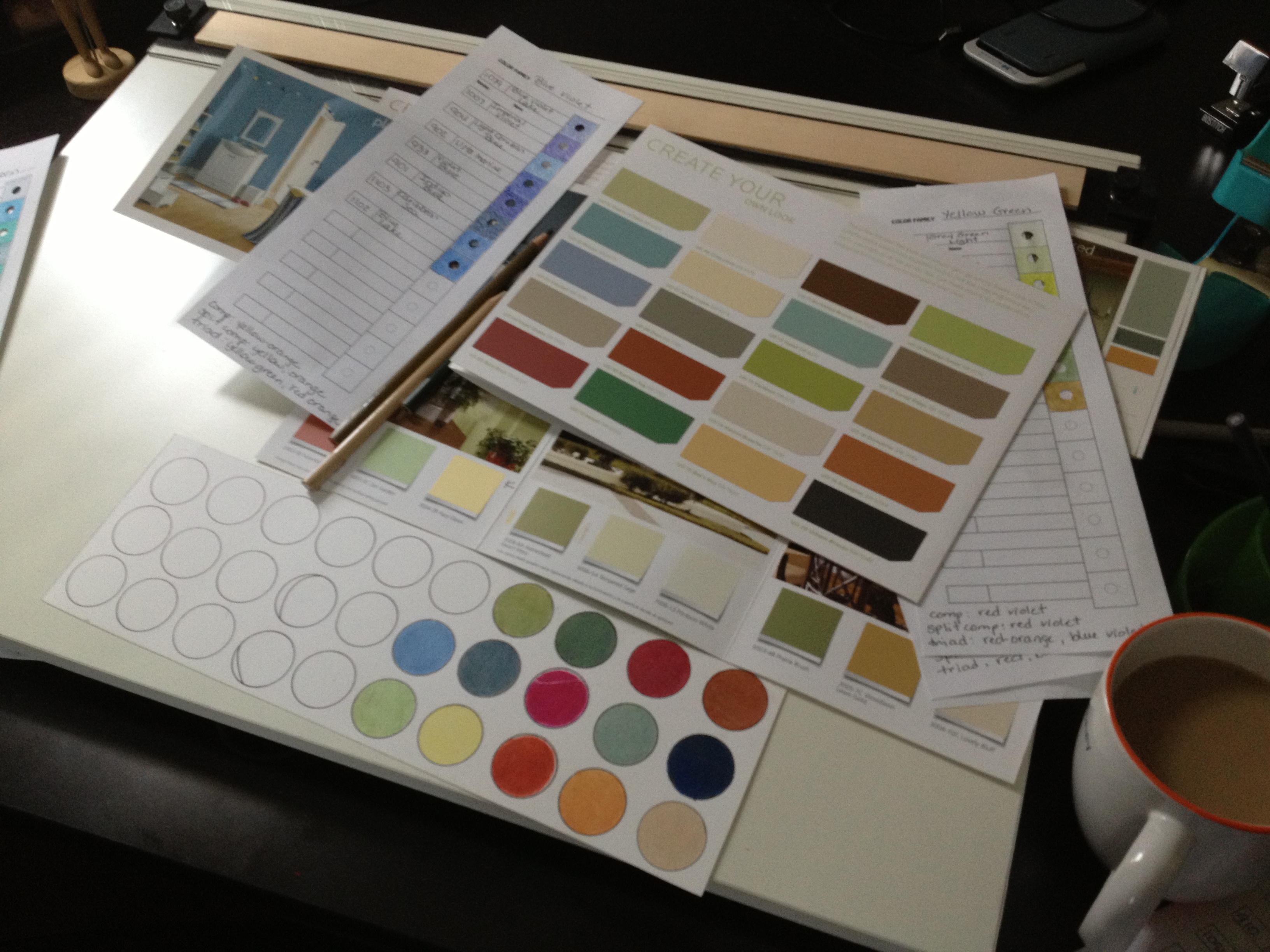
The color I am mixing is 5002-108 Pool Party from Valspar. I am using the back of an index card, 132 Prismacolor set, and my color family charts.

tb

As I lay the chart over the swatch, I notice that true blue from the blue family is the closest match to Pool Party. After, I painted true blue I noticed the color wasn’t deep enough and I needed a deeper blue.

tb mb

  I added a layer of Mediterranean Blue and the depth is close, but not close enough. I still needed a deeper blue.

tb mb s graayI added a layer of slate gray. And now I have the depth I need, but it too dull.

tb md b slate g true blue I added a layer of true blue to get the vibrancy back.  Remember, In the beginning I chose True Blue because it was the closest.
And there you have it.

I mixed this color in 4 layers using 3 pencils.  I hope you noticed that I used the same color family. The fact that these pencil colors were in a row, is an accident.  My family is not in any particular order. 

So to recap:

1.)  Find the closest match to color you want to mix.

2.) If you need to lighten  choose a lighter hue or darken choose a darker hue, but from the same family

3.) Add your closest match back on top.

Which brings us to your next lesson. 

Get your chips, pencils and color family charts and start mixing.

Use your drawing paper, index cards or whatever you can find. Draw 1 in. diameter circles and fill those with your color mixes.

You will be doing this for a bit!

Other lessons:

Color Theory and the Color Wheel

Techniques 1

Techniques 2

Enjoy!

Be Well and Happy!